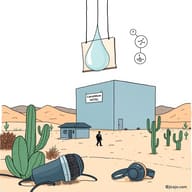
Meta's Arizona Data Center Water Permit Suspended Over Pollution
Show notes
Meta faces a water permit suspension in Arizona after its data center discharges contaminated the local supply, highlighting tensions between AI infrastructure and environmental limits. A County Wicklow hotel cancels a secretive Peter Thiel-linked conference days before it was set to begin. Verizon retires its Number Share feature for kids' Android smartwatches with no replacement, leaving parents without a key safety tool. Plus: Webb Telescope galaxies that break the cosmic timeline, retro gami
Timeline
- 00:00:00 Opening
- 00:00:25 Meta Data Center Water Permit Suspended
- 00:01:23 Webb Telescope's Unexpected Early Galaxies
- 00:02:21 Wicklow Hotel Cancels Peter Thiel-Linked Conference
- 00:03:31 Finland's Last Analogue Landlines Go Silent
- 00:04:28 Verizon Pulls Safety Feature from Kids' Smartwatches
- 00:05:20 Retro Gaming Revival: Dreamcast and C&C Generals on Modern Hardware
- 00:07:00 Zig Moves Package Management from Compiler to Build System
- 00:07:56 YouTube Private Creator Videos Exposed
- 00:08:59 CO₂ Buildup: The Hidden Meeting Room Bottleneck
- 00:09:37 $200K Bounty for Mass Book Scan Exfiltration
- 00:10:37 Potential Session Leak Between Workspace Instances
Related links
- Meta data center water discharges suspended for contaminating water supply - Bri Hacker News Campaign Feed
- Astrophysicists Puzzle over Webb’s New Universe - Bri Hacker News Campaign Feed
- Wicklow hotel cancels 'secretive' Peter Thiel group conference - Bri Hacker News Campaign Feed
- Finland's last analogue landline phones go silent after 150 years - Bri Hacker News Campaign Feed
- Verizon is About to Break our Watches - Bri Hacker News Campaign Feed
- Windows CE Dreamcast Community Edition (wince-dc) - Bri Hacker News Campaign Feed
- Command and Conquer Generals natively ported to macOS, iPhone, iPad using Fable - Bri Hacker News Campaign Feed
- Zig: All Package Management Functionality Moved from Compiler to Build System - Bri Hacker News Campaign Feed
- Leaking YouTube creators' private videos - Bri Hacker News Campaign Feed
- The bottleneck might be the air in the room - Bri Hacker News Campaign Feed
- Google Books (or similar) all book scans – $200k bounty (2025) - Bri Hacker News Campaign Feed
- Potential session/cache leakage between workspace instances or consumer accounts - Bri Hacker News Campaign Feed
This episode is produced by Bri. Bri uses advanced AI technology to turn the feeds you care about into podcasts made for listening. Contact us at hi@bri.so.
Transcript
Mia: Welcome to HackerNews Daily, a Bri podcast. I'm Mia.
Milo: And I'm Milo. Today: Meta's Arizona data center has its water permit suspended over pollution concerns, a hotel in County Wicklow cancels a Peter Thiel-linked conference days before it starts, and Verizon pulls a safety feature from kids' smartwatches with no replacement in sight.
Mia: Meta just had its Arizona data center water permit suspended over pollution concerns.
Milo: That’s a big deal. The state found the facility’s discharges were contaminating the local water supply.
Mia: Exactly — not just a fine, but an actual suspension.
Milo: The core issue is that the cooling systems at these hyperscale data centers use immense amounts of water.
Mia: And when the water cycles through and gets discharged, it picks up chemicals or raises temperatures enough to harm local ecosystems.
Milo: In this case, regulators stepped in and stopped those discharges outright.
Mia: So this isn’t a theoretical risk — it’s a direct, measurable impact on one community’s water.
Milo: And the consequence is real: Meta must halt operations tied to that permit until the problem is fixed.
Mia: That pause hits the tension between building AI infrastructure fast and local environmental limits.
Mia: The universe is turning out to be… not what we expected.
Milo: Right, the early galaxies from the Webb telescope just don’t fit the old story.
Mia: What makes them so hard to explain?
Milo: They look too big and too bright for their age. Like finding a fully grown forest where you expected only saplings.
Mia: So the timeline of how fast galaxies can form — that's off?
Milo: Exactly. The light from those galaxies traveled over thirteen billion years to reach us.
Mia: That means we’re seeing them when the cosmos was barely a baby.
Milo: And that’s the puzzle — they already had lots of mature stars. Too many.
Mia: If the old models can’t make stars that quickly, what’s the favorite fix?
Milo: One idea is that stars lit up way earlier, or black holes played a bigger role than thought.
Mia: Either way, it means the cosmic cookbook needs a serious rewrite.
Mia: A hotel in County Wicklow has cancelled a conference linked to a Peter Thiel‑backed network, just days before it was due to start.
Milo: And the organisers kept the event unusually quiet. No public agenda, no open registration — just a private gathering under a generic company name.
Mia: Right. The resort pulled the booking after management realised who the real host was — a group called the Network for Constitutional Change.
Milo: That name didn’t ring any bells for me at first either. Turns out it’s tied to a wider Thiel‑funded effort that works on reshaping legal and political systems.
Milo: So when the hotel understood the nature of the group, they decided the event didn’t align with their values and told the organisers it couldn’t go ahead.
Mia: That’s a strong signal for a venue that rarely wades into politics. And it shows how quietly these networks operate — until a local decision suddenly pulls back the curtain.
Milo: Which leaves a practical question: where do you draw the line between a private meeting and a public-interest risk, especially when secrecy is baked in from the start?
Mia: After a century and a half, Finland’s last analogue landline exchanges have switched off for good.
Milo: It’s a clean end to a technology that started back when Finland was still part of the Russian Empire.
Mia: The remaining copper-wire phone lines in a handful of municipalities got replaced by modern 4G and 5G voice services.
Milo: So no dial tone, no physical wire into the house — just a mobile network call that feels the same to most users.
Mia: The hardware was actually still working fine, but the operating costs of maintaining ageing exchange equipment no longer made sense.
Milo: That’s the practical reality. For anyone who relied on a corded phone during a long power cut, this does remove one last low-power lifeline.
Mia: But the operators say modern base stations have backup batteries, and voice-over-LTE can handle emergency calls more reliably today.
Mia: Some Verizon smartwatch owners are about to lose a core feature, and it is not a bug. It is a planned network shutdown.
Milo: Planned in what way exactly?
Mia: Verizon is retiring its Message Plus app, which powers the Number Share feature on cellular Android watches for kids.
Milo: So a child's watch with its own phone number will stop syncing calls and texts with the parent's phone.
Mia: Right. Verizon says it will pull those watches from sale and disable Number Share, but it has not announced a replacement.
Milo: And this hits a specific group. Parents who rely on that independent connection for safety.
Mia: Exactly. Without Number Share, the watch reverts to a standalone line with no call or message mirroring.
Milo: So a kid could still dial out, but the parent loses the seamless link they bought into.
Mia: From a homebrew Dreamcast tool to a classic RTS on your phone—retro gaming is punching through some serious hardware walls right now.
Milo: And both of these projects share a common thread: they are taking officially abandoned platforms and giving them modern legs.
Mia: Let's start with the Dreamcast. A new "Community Edition" of Windows CE for the console just dropped.
Milo: Windows CE was the official Microsoft toolkit that let devs port PC games to the Dreamcast back in the day. This new release revives that exact development environment, but for homebrew creators today.
Mia: So now hobbyists have a cleaner path to get new games or tools running on actual vintage hardware. It keeps the library alive.
Milo: And the second project feels like a similar unlock, but for Apple devices this time.
Mia: Command & Conquer Generals—the classic real-time strategy game—has been natively ported to macOS, iPhone, and iPad.
Milo: The key word here is "natively." This isn't an emulator or streaming from a PC. It's a full translation layer called Fable that lets the original C++ code run directly on Apple Silicon.
Mia: So it's not just playable—it's running with native performance and battery efficiency. A Windows game from 2003, running smoothly in your pocket.
Milo: That's the core shift here. In both cases, the community isn't waiting for a corporate re-release. They are building the compatibility themselves, making old tech live on new hardware right now.
Mia: Speaking of build systems, Zig just made a big move that tries to solve one of those problems directly.
Milo: What kind of problem?
Mia: Why do you need a compiler just to fetch a library? That’s the exact question the Zig team asked.
Milo: So they pulled package management out of the compiler?
Mia: Exactly. They moved the whole package management system from the compiler into the build system.
Milo: That’s a pretty fundamental shift.
Mia: It means the compiler is now leaner, and the build system handles dependencies, version resolution, and fetching.
Milo: So in practice, the compiler doesn't need to know about the network at all anymore.
Mia: Right. The concrete consequence is that you can manage Zig projects without giving the compiler access to the outside world.
Milo: That also reduces attack surface and speeds up compiler upgrades.
Mia: Yeah. It separates two concerns that never really needed to be glued together.
Mia: There's a new report about private, unlisted YouTube creator videos getting exposed.
Milo: So these aren't public videos—just ones creators shared with a limited audience?
Mia: Right. A security researcher found that private or unlisted video links can leak through an unintended channel.
Milo: What's the exact vector — how do the links get out?
Mia: The researcher detailed how the YouTube video ID combined with a specific API permission can reveal access that was never meant to be public.
Milo: That means a video a creator sent to sponsors or collaborators could end up watchable by strangers.
Mia: Exactly. And the scary part is that a deleted private video could still be fetchable for a brief window after removal.
Milo: So even taking the video down doesn't guarantee it's gone.
Mia: No—the core takeaway is that private on YouTube isn't airtight, and creators need to treat sensitive links as potentially leakable.
Milo: Good reason to limit who gets those links in the first place.
Mia: Sometimes the biggest bottleneck in a room isn't the hardware or the code — it's literally the air.
Milo: Right. And when CO₂ builds up, your brain just slows down. Studies show that even moderate levels, like 1,000 parts per million, can hurt decision-making.
Mia: So what happens in a typical meeting room with a few people and the door closed?
Milo: It can easily cross 1,400 ppm in under an hour. That's well into the zone where cognitive function scores start dropping.
Mia: So the fix might be simpler than another productivity tool. Just open a window.
Mia: Here's something wild that puts a different kind of price tag on digital access—there's a $200,000 bounty from 2025 targeting scans of every single book.
Milo: And we're not talking about grabbing a few PDFs. This bounty called for bypassing DRM on a massive scale—essentially scraping Google Books' full-scan archive.
Mia: What makes this different from a typical piracy hunt?
Milo: The scale alone. The target wasn't a single work or a small leak—it was programmatic mass exfiltration, and that $200,000 price tag signals a serious buyer, not casual curiosity.
Mia: So it framed the library of everything not just as a knowledge project, but as a physical-level target for pure machine-driven extraction.
Milo: Exactly—and it shows the counter-pressure is scaling up too, turning entire repositories into a single high-stakes asset to defend.
Mia: There is a story bubbling on Hacker News about a potential session or cache leak between workspace instances, and it is worth watching even though the original article is unavailable.
Milo: What exactly are we looking at here?
Mia: The title flags possible leakage between workspace instances or consumer accounts, meaning one user’s session data could bleed into another’s workspace.
Milo: That is a serious isolation failure. A shared cache accidentally serving another account’s tokens or draft content would break the most basic tenant boundary.
Mia: Right, and with 275 points on HN the concern is catching attention, but the missing source article means we cannot confirm whether this is a reported bug, a penetration test finding, or a configuration warning.
Milo: For listeners running multi-tenant SaaS or productivity tools, the immediate takeaway is to review session-store isolation and cache-key scoping before this pattern surfaces in your own stack.
Mia: That session-isolation concern is still developing, so we'll keep an eye on it. Thanks for listening.
Milo: We'll be back with more. Talk soon.