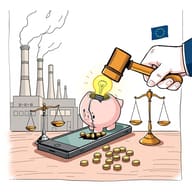
Google's €4.3 Billion EU Fine Sticks as Insiders Flag Deeper Cultural Crisis
Show notes
Google loses its final EU antitrust appeal and faces a €4.3 billion fine over Android bundling, while a departing VP's farewell letter accuses leadership of losing its moral compass. Infineon opens a five-billion-euro chip plant in Dresden, advancing Europe's push for semiconductor autonomy. Japan's top court rules AI cannot be listed as a patent inventor, Spain blacklists Palantir from public contracts, and Virginia bans warrantless geolocation data sales. Plus: a Linux LUKS encryption bug, the
Timeline
- 00:00:00 Opening
- 00:00:27 Google loses record €4.3 billion EU antitrust appeal
- 00:01:56 Infineon opens €5 billion chip plant in Dresden
- 00:03:26 Japan rules only humans can be inventors; Spain blacklists Palantir
- 00:05:20 Virginia bans geolocation data sales; EFF presses FTC on X
- 00:06:43 Linux LUKS suspend bug leaves encryption keys in memory
- 00:08:09 DNA solves mystery of Everest's 'Green Boots' climber
- 00:09:03 Single frozen layer matches full RL training; short-leash coding beats Fable
- 00:10:35 Egg producers fined a fraction of price-fixing profits
- 00:11:19 MCP Cloud launch and Claude-real-video let any LLM watch video
- 00:13:13 LMDB 1.0 released; crustc translates the Rust compiler to C
- 00:14:21 Immich 3.0 shifts to web-first self-hosted photo server
Related links
- Google loses fight over record $4.7B EU antitrust fine - Bri Hacker News Campaign Feed
- Why I'm Forced to Say Farewell: Google Management Has Lost Its Moral Compass - Bri Hacker News Campaign Feed
- Germany’s Infineon opens major chip plant as EU seeks tech autonomy - Bri Hacker News Campaign Feed
- AI can't be listed as inventor on patent applications, Japan's top court rules - Bri Hacker News Campaign Feed
- Spain Orders Blacklist of Palantir from Public and Private Companies - Bri Hacker News Campaign Feed
- Virginia bans sale of geolocation data - Bri Hacker News Campaign Feed
- EFF letter to FTC on X consent order (2 July 2026) [pdf] - Bri Hacker News Campaign Feed
- Since Linux 6.9, LUKS suspend stopped wiping disk-encryption keys from memory - Bri Hacker News Campaign Feed
- Mystery identity of 'Green Boots' climber is finally solved after DNA test - Bri Hacker News Campaign Feed
- Is One Layer Enough? A Single Transformer Layer Matches Full-Parameter RL Train - Bri Hacker News Campaign Feed
- The short leash AI coding method for beating Fable - Bri Hacker News Campaign Feed
- The Egg Bandits Made a Thousand Times the Fine They Just Paid for Price Fixing - Bri Hacker News Campaign Feed
- Launch HN: Manufact (YC S25) – MCP Cloud - Bri Hacker News Campaign Feed
- Claude-real-video - any LLM can watch a video - Bri Hacker News Campaign Feed
- Lightning Memory-Mapped Database Manager (LMDB) 1.0 - Bri Hacker News Campaign Feed
- crustc: entirety of `rustc`, translated to C - Bri Hacker News Campaign Feed
- Immich 3.0 - Bri Hacker News Campaign Feed
This episode is produced by Bri. Bri uses advanced AI technology to turn the feeds you care about into podcasts made for listening. Contact us at hi@bri.so.
Transcript
Mia: This is HackerNews Daily, a Bri podcast. I'm Mia.
Milo: And I'm Milo. Today: Google loses its final EU antitrust appeal with a €4.3 billion fine, Infineon opens a five-billion-euro chip plant in Dresden, and Japan's top court rules that only humans can be inventors. Let's get into it.
Mia: Google just lost its final appeal against a record €4.3 billion EU antitrust fine, roughly $4.7 billion.
Milo: So the European Union’s highest court agreed the company abused its dominance with Android. What exactly did Google do that triggered this?
Mia: The EU found Google forced phone makers to pre-install search and Chrome as a bundle. That blocked rivals like Firefox or alternative search engines from even getting on devices.
Milo: And it didn’t stop there. Google also paid big manufacturers and carriers to lock in Google as the exclusive search default.
Mia: Right, so a rival couldn’t bid for placement even if they had a better product. The court called that combination an illegal restriction of competition.
Milo: And there’s a wider pattern here. A departing Google VP just put out a blunt farewell letter saying “Google management has lost its moral compass.”
Mia: He traces it to a 2019 all-hands where leadership skipped a hard ethics discussion and promised only “increased pomp and circumstance.”
Milo: His claim is that the same short-term, profit-first mindset that seeded the Android case now runs much deeper inside the company.
Mia: The EU fine closes the legal book on one specific abuse. The insider letter paints it as part of a cultural slide the company still hasn’t addressed.
Mia: The EU just landed one of its biggest chip-manufacturing wins, and it is not a foreign name building on the continent.
Milo: Right—Infineon, a German company, is opening a big new plant in Dresden.
Mia: The facility is called Smart Power Fab, and it will make chips on 300-millimeter wafers for power electronics and analog mixed-signal applications.
Milo: So in practice we are talking about chips that go into things like EV charging, renewable-energy systems, and industrial motor drives.
Mia: Exactly—the kind of parts where efficient power conversion matters.
Milo: One number that stands out: total investment is five billion euros.
Mia: Five billion euros. And the plant is expected to create up to one thousand new jobs.
Milo: The wider story here is EU tech autonomy.
Mia: That is the real anchor. The EU Chips Act set a target of doubling Europe’s share of global chip production to twenty per cent by 2030.
Milo: And Infineon’s plant fits directly into that push, reducing reliance on supply chains that proved fragile during the pandemic.
Mia: One concrete consequence: this capacity is meant to support Europe’s green transition. Without local chip supply, decarbonisation timelines slip.
Milo: So the thing to watch now is whether the next wave of EU-funded fabs hits their milestones on schedule, because this one sets a high bar.
Mia: Japan’s top court just drew a hard line around a deceptively simple question: who—or what—can be an inventor?
Milo: And their answer is clear. Under Japanese patent law, an inventor must be a natural person. An AI cannot be listed, period.
Mia: The case started when someone tried to name an AI as the sole inventor on a patent application. The Japan Patent Office refused, and the court just backed that refusal with a final ruling.
Milo: What lifts this above a procedural footnote is what the court did not do. It didn’t touch the bigger question of whether an AI can truly invent at all.
Mia: Right, the judges left that completely open. They simply said the law as written requires a human, and clarifying anything beyond that is a job for the legislature, not the courts.
Milo: That means a company using AI to generate a novel drug compound might still get a patent—but only if a human is listed as the inventor who contributed to the conception. The AI stays a tool, not a creator.
Mia: And that tension between AI-as-tool and AI-as-creator isn’t staying in the patent office. Spain just ordered a sweeping blacklist of Palantir from public and private-sector contracts, citing ethical violations tied to data privacy and surveillance.
Mia: This wasn't a narrow tech decision. It came from Spain's Ministry of Consumer Affairs, which framed it as a move to protect citizens from algorithmic profiling.
Milo: The practical effect is immediate: any company or public body in Spain that keeps working with Palantir risks losing access to European funding. That’s a financial lever, not just a statement.
Mia: Virginia just became the latest state to ban the sale of geolocation data—no warrant, no sale.
Milo: And it lands right when the EFF is pressing the FTC on a separate but connected problem: X's consent order from back in 2011.
Mia: The Virginia law is pretty direct. It stops data brokers from selling precise location data that comes from phones, cars, or apps, unless there's a warrant or an emergency.
Milo: So a broker can't just sell a list of where every phone went last Tuesday?
Mia: Exactly. And the EFF letter argues X has been doing something with a similar effect. X has been pulling location data into its AI and ads system, which looks like it breaks the old FTC order that said user data can't be used beyond what people originally agreed to.
Milo: Right—the original consent order said X, then Twitter, could use data only for specific security and safety purposes, not for targeting or training models.
Mia: So if the FTC enforces that, X could face real consequences: halting ad models or even a new fine structure. That combined with Virginia's law means geolocation data is getting squeezed on two fronts right now.
Mia: There’s another privacy thread that isn’t about laws or regulators. It’s a quiet bug inside the machine itself—one where your full-disk encryption keys can still be sitting in memory after you think you’ve locked everything down.
Mia: Exactly. Since Linux kernel 6.9, the LUKS suspend command— the one meant to freeze an encrypted volume and wipe its keys from RAM—has been broken.
Milo: Wait, totally stopped wiping them?
Mia: The report says it stopped clearing the master encryption key from memory. You run suspend, the volume looks locked, but the key stays live in RAM.
Milo: So an attacker who can read memory after that point—cold boot, physical access, or a kernel exploit—can just recover the key and decrypt the whole drive.
Mia: And that completely defeats the point of suspending instead of just closing the lid and hoping the screen lock holds.
Milo: That’s a long window. The bug’s been present since kernel 6.9, and LUKS is the default disk encryption on most Linux distros.
Mia: The practical consequence is clear: if you relied on LUKS suspend as your last line of defense for a powered-on machine, you didn’t actually have that protection.
Milo: And nobody noticed until the community dug into memory behavior. That also tells you something about how invisible this class of bug can be in production.
Mia: Now from a kernel bug that leaves secrets in memory to a mystery that was literally frozen on a mountain for decades— you've probably seen the photo: a climber in bright green boots lying in a small cave on Everest's northeast ridge.
Milo: That image has haunted mountaineers for years. The body became a grim waypoint, but nobody could say for sure who it was, despite years of speculation.
Mia: What changed?
Milo: A documentary team recovered a DNA sample from the remains and matched it to a family member. The test confirmed the climber was Tsewang Paljor, an Indian mountaineer who died in the 1996 Everest disaster.
Mia: So the mystery is finally closed—not by new documents, but by direct DNA. It ends a decades-long question mark for his family and the climbing community.
Mia: Some researchers just published a pretty wild finding: a single frozen transformer layer, fine-tuned on top of a pre-trained model, matched or beat full RL training on several code benchmarks.
Milo: Wait, one layer—not the whole model?
Mia: Exactly, just the last layer. In their paper “Is One Layer Enough?” they show that on tasks like LiveCodeBench, a single-layer LoRA adapter matched training the full model with GRPO.
Milo: That’s a much cheaper path to the same result, then.
Mia: And it gets extra interesting next to that “short leash” coding method. A team used a constrained LLM pipeline that basically locks down the AI’s freedom—short context windows, forced checklists, coarse file creation—and it swept all five tracks of the Fable benchmark.
Milo: So two different philosophies: one says a tiny tuning surface gets you RL-level performance, the other says strongly constraining an LLM beats simulators built for creative writing.
Mia: Right. Together they suggest the next big coding assist gain might not come from bigger RL runs, but from cheaper fine-tuning plus deliberately restrictive coding guardrails.
Milo: Which flips the usual assumption that more model control always means worse results.
Mia: So many food-price stories right now focus on the supply chain, but here’s one that’s a lot more direct: egg producers admitted to price-fixing.
Milo: Wait—this is a new settlement, not just the same old lawsuit?
Mia: Yes, a jury originally found them liable for conspiring to reduce supply and drive up prices.
Milo: And the fine that just landed is supposedly the punchline.
Mia: The judgment was twenty-five million dollars, but court documents estimate the scheme generated at least two hundred forty times that in extra revenue.
Milo: So the penalty is effectively just a tiny cost of doing business.
Mia: Exactly—and the families paying more per dozen never get that difference back.
Mia: So after all that talk about pricing algorithms, here is a different angle on the automation wave — it is now reaching the tools developers use every day to connect AI models to external services.
Milo: Right, and a new YC batch launch called Manufact is attacking that exact layer. It is an MCP Cloud — so instead of every developer running their own local bridge between an LLM and an API, they host and manage that middleware for you.
Mia: Does that actually change much beyond moving the same glue code to a server?
Milo: It changes the reliability story. Local MCP servers crash, drift out of sync, and break when a token rotates. A hosted cloud version can keep those connections alive, handle auth, and even pool common external tools across teams. That turns MCP from a weekend sidecar into something you might trust in production.
Mia: And on the model side, there’s a parallel unlock. A project called Claude-real-video just showed any LLM can watch a video by feeding it a stream of frames and a text prompt.
Milo: Which is a bigger deal than it sounds. Until now, video understanding usually meant a proprietary multimodal model with its own video encoder. This approach decouples the visual pipeline, so even a fairly standard text model can describe what is happening in a clip, second by second.
Mia: So one thread lowers the infrastructure barrier for AI to act, and the other lowers the barrier for AI to see.
Milo: And the concrete consequence is speed — a small team can now prototype an agent that watches a live camera feed and calls an external tool, all without building either the video ingestion or the orchestration layer themselves.
Mia: Two infrastructure-level projects landed this cycle that both quietly shift what "from scratch" can mean.
Milo: Both are about lower-level storage or compilation, not the user-facing layer.
Mia: First, the Lightning Memory-Mapped Database hit 1.0.
Milo: LMDB is an embedded key-value store that runs inside the process and is famously read-optimized.
Mia: The 1.0 designation signals a long-stable API and production-readiness contract, not a feature explosion.
Milo: Which matters because many systems already depend on it without a formal stability promise.
Mia: The other project is crustc: the entirety of the Rust compiler, rustc, translated to C.
Milo: So a Rust-to-C transpilation of the compiler itself, producing a C codebase you can build without a Rust bootstrap.
Mia: It’s a supply-chain play—more platforms can now host a working Rust toolchain through a C compiler path.
Milo: Taken together, both moves lock in existing infrastructure rather than inventing new abstractions.
Mia: Immich 3.0 is out, and the big headline is that it's shifting from a mobile-first sync tool toward running as a proper server you access through a browser.
Milo: So it’s becoming more like Google Photos that you host yourself, rather than just a backup daemon.
Mia: Exactly. It’s a deliberate architectural turn—they even moved from mobile-only admin to full web-first management.
Milo: That changes the pitch for anyone running it on a home server. You get a full web UI, and your phone becomes one of several clients instead of the control center.
Mia: That's it for today's episode of HackerNews Daily from the Bri podcast network. Thanks for listening.
Milo: We'll be back tomorrow with more stories that matter. Talk to you then.